|
 HE ROAD
from Milano to Genova, the A7, has to be one of the most entertaining,
and, fortunately, it is not greatly spoiled by the sight of toll
booths as frequently as other stretches of autostrada.
When you first depart Milano—not a difficult task, considering you
can easily go against the signs that point toward the city centre—there
are numerous ways to head down toward a town close to the famous
Cinque Terre, but the A7 gets my vote. HE ROAD
from Milano to Genova, the A7, has to be one of the most entertaining,
and, fortunately, it is not greatly spoiled by the sight of toll
booths as frequently as other stretches of autostrada.
When you first depart Milano—not a difficult task, considering you
can easily go against the signs that point toward the city centre—there
are numerous ways to head down toward a town close to the famous
Cinque Terre, but the A7 gets my vote.
I had filled up at a station where I was mistaken
for French—my 94-district number plates from France were recognizable,
even if I didn't have the little blue strip down the left that designated
which European nation I had come from. An Italian said in broken
French that he was out of money and tried to flog me some bad-looking
jewellery; I neglected to tell him that I worked sometimes in the
fashion publishing business and humoured him for a while as he did
his Italian Job with his gold before tiring of the charade and declined
naming a price for trinkets I neither wanted nor cared for.
As I neared Genova, the roads became delightfully
narrow, there were increasing numbers of thousand-foot drops to
my right and the two lanes that went toward the ancient seaside
town suddenly were the delight of any Italian driver obsessed with
playing the stick shift. I joined them, racing my Opel Astra Turbo
Diesel with Golfs and Focuses bearing number plates from nearby
Italian towns. Gone are the days when one bought the local brand;
the taxi drivers I met in Milano, with whom I had interesting chats
about women (the only topic we had in common), drove Opels, Citroëns
and other foreign makes. Fiat is hæmorrhaging millions a day, and the amounts still sound a lot to the locals even after euronating,
so confidence isn't particularly high—before long they would be
taking the piss out of their own cars.
Italians hate automatics. About two per cent of
automobiles have automatic transmissions. There is something about
being in control continuously, and that includes seat belt usage—an
informal poll of the "next 10 cars" I saw in Genova put the figure
at 30 per cent—something the automatic transmission does not allow
"real" drivers obsessed with Ferraris and Maseratis. And rightly
so, as I shifted down to third to maintain pace with the Focus Turnier
driver but keep the pace up at 90 km/h round the corner. Accustomed
to the pace of German autobahnen, I attempted to keep my
average at 140 km/h. They are good at speed; further north nearer
the Swiss border, drivers had had trouble staying in their lane.
These Italian Riviera routes, the old motorways,
are too short and to die for, much like the Moyenne Corniche which
I would later sample. The Corniche has been filmed often so the
A7 is already a more enriching driving experience and far more entertaining.
There should be more of these roads, but the must-be-there yesterday
crowd in campervans and trucks have seen to the advent of the autostrada
and with it, tolls. There are plenty in Italy nearer the cities,
but thankfully someone remembered that A roads should not be all
dull and sterile. This stretch of the A7 was perfect for the driver
and it was with some disappointment that I got in to Genova. It
would not be as much fun going the opposite, less risky direction.
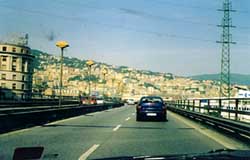
Keen to maintain my pace and enjoy the eye-candy
of blue sun reflecting off the Mediterranean Sea, I took the coast
road and refrained from rejoining the Italian freeway system where
the toll booths would begin again. The pace was poor but the sights
were plenty, with nice, winding roads to challenge the best drivers.
But as I drove, following signs to La Spezia, I came across Portovenere,
a seaside town that was not too far away from the Corsican ferry,
an Italian naval base and some of the most delightful seafood restaurants
that I had found on the Italian west coast. Further south, it was
better than Cinque Terre, because it is regarded as the "sixth
town", escaping much of the tourism that had spoiled the other
five.
continued:
in Portovenere 
|


|






 Copyright ©2002 by JY&A Media, a division of Jack Yan & Associates. All rights reserved.



 @
@